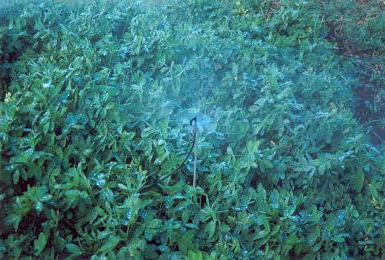
 |
|
 |
|
| Micro tube spac-ing (m) | Micro-tube length (cm) | Operating pressures (kg/cm2) | |||||||
| 0.6 | 0.8 | 1.0 | 1.2 | ||||||
| Optimum length of lateral (m) | Disch-arge of micro-tube (lph) | Optimum length of lateral (m) | Disch-arge of micro-tube (lph) | Optimum length of lateral (m) | Disch-arge of micro-tube (lph) | Optimum length of lateral (m) | Disch-arge of micro-tube (lph) | ||
| 1.5 | 50 | 30 | 9.41 | 33 | 11.57 | 37.5 | 12.59 | 39 | 14.76 |
| 100 | 33 | 6.14 | 34.5 | 7.94 | 37.5 | 9.27 | 42 | 10.28 | |
| 150 | 34.5 | 4.95 | 39 | 6.15 | 39 | 7.86 | 45 | 8.57 | |
| 200 | 40.5 | 4.67 | 43.5 | 6.13 | 48 | 7.17 | 51 | 8.13 | |
| 3 | 50 | 54 | 9.99 | 57 | 12.66 | 63 | 13.95 | 66 | 15.89 |
| 100 | 60 | 8.15 | 63 | 8.95 | 66 | 11.16 | 72 | 11.53 | |
| 150 | 60 | 6.28 | 69 | 8.46 | 75 | 9.19 | 75 | 10.41 | |
| 200 | 72 | 5.34 | 84 | 6.74 | 84 | 7.92 | 87 | 9.59 | |
|
|
 |
 |
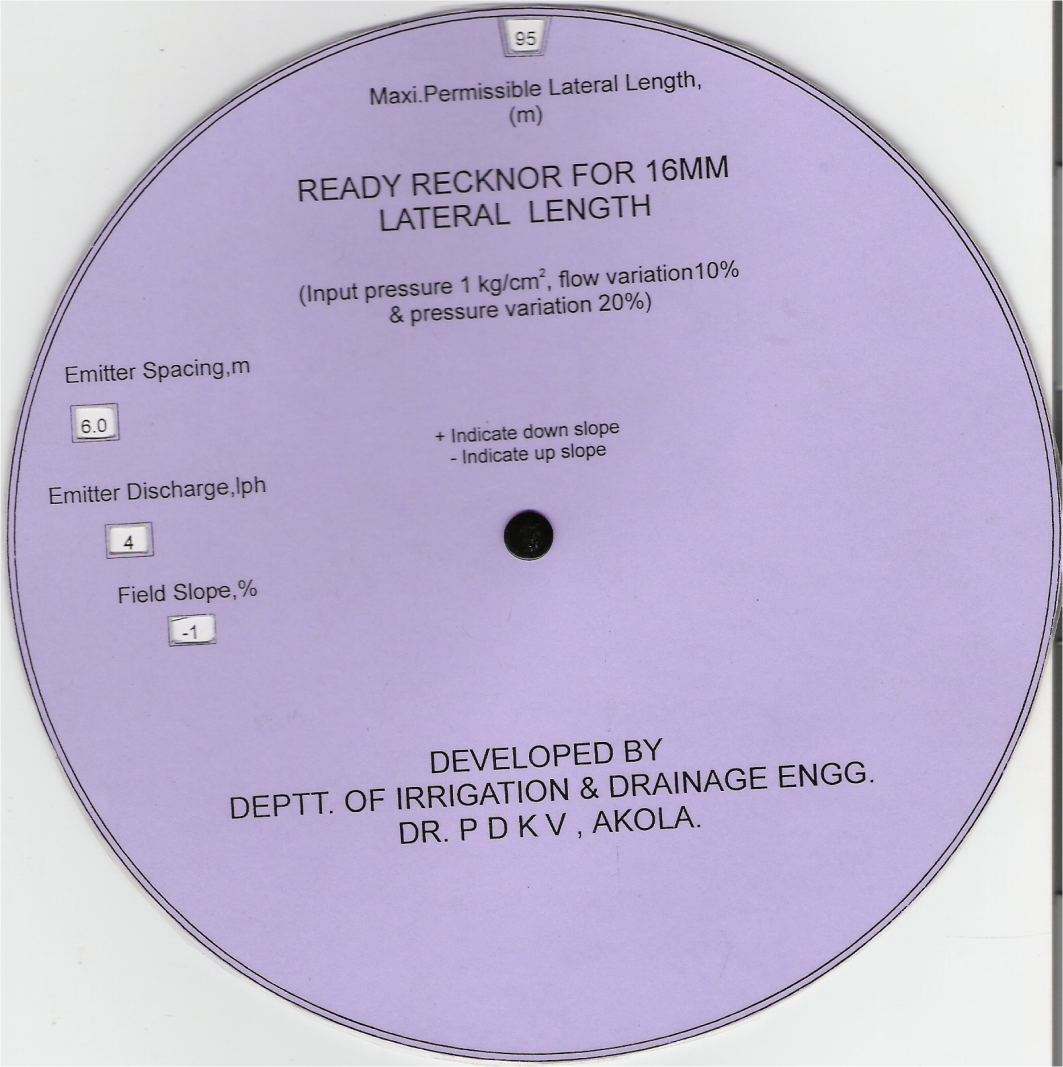
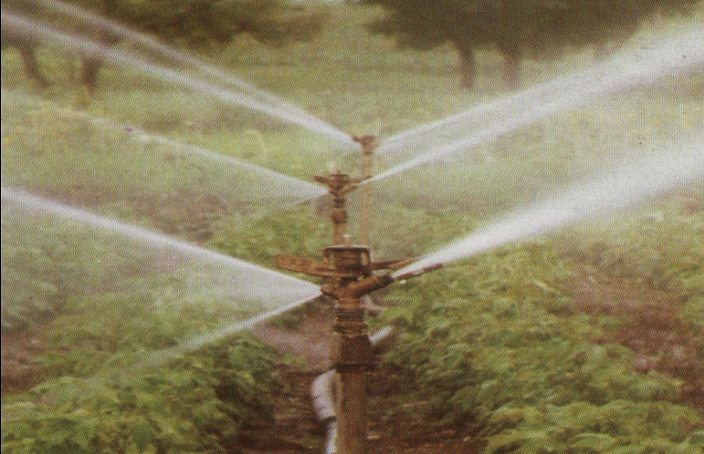
- It is recommended to use the PKV developed ready recknor for deciding optimum length of lateral for selected combination of dripper spacing along lateral, dripper discharge and field slope in design of online drip irrigation system.
Table: Ready recknor for 16 mm lateral length (Inlet pressure-1 kg/cm2)
| Field slope, % | Emitter discharge rate, lph | Maximum permissible lateral length for different online dripper spacing, m | |||||
| 0.6 | 1.2 | 1.8 | 2.4 | 3.0 | 6.0 | ||
| +1 | 4 | 45 | 60 | 65 | 75 | 95 | 125 |
| 8 | 40 | 50 | 60 | 70 | 85 | 110 | |
| +2 | 4 | 45 | 65 | 70 | 80 | 100 | 145 |
| 8 | 40 | 55 | 70 | 80 | 95 | 130 | |
| +3 | 4 | 50 | 70 | 80 | 90 | 115 | 160 |
| 8 | 45 | 60 | 80 | 85 | 100 | 145 | |
| -1 | 4 | 40 | 55 | 60 | 70 | 90 | 110 |
| 8 | 35 | 40 | 55 | 65 | 75 | 95 | |
| -2 | 4 | 35 | 50 | 60 | 65 | 80 | 95 |
| 8 | 30 | 35 | 50 | 55 | 65 | 80 | |
| -3 | 4 | 35 | 45 | 50 | 60 | 70 | 90 |
| 8 | 25 | 30 | 40 | 45 | 55 | 70 | |
 |
|
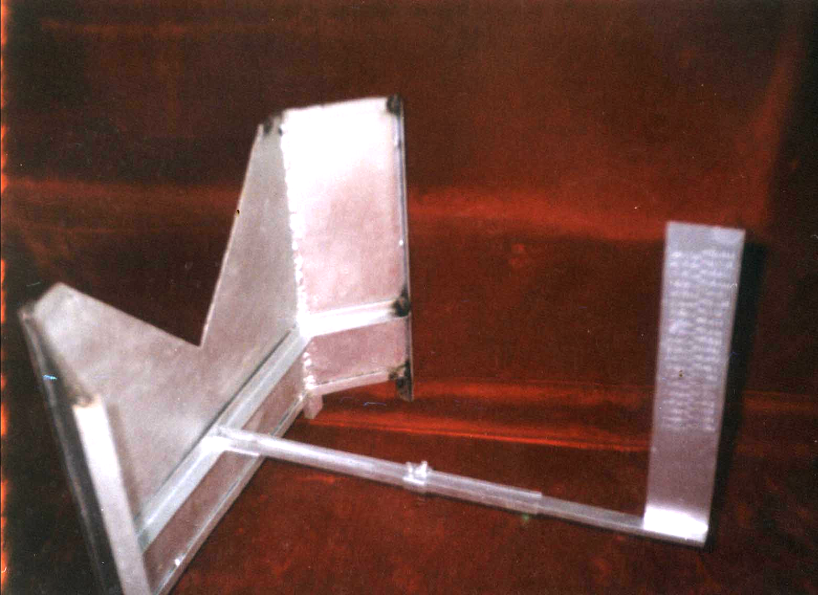
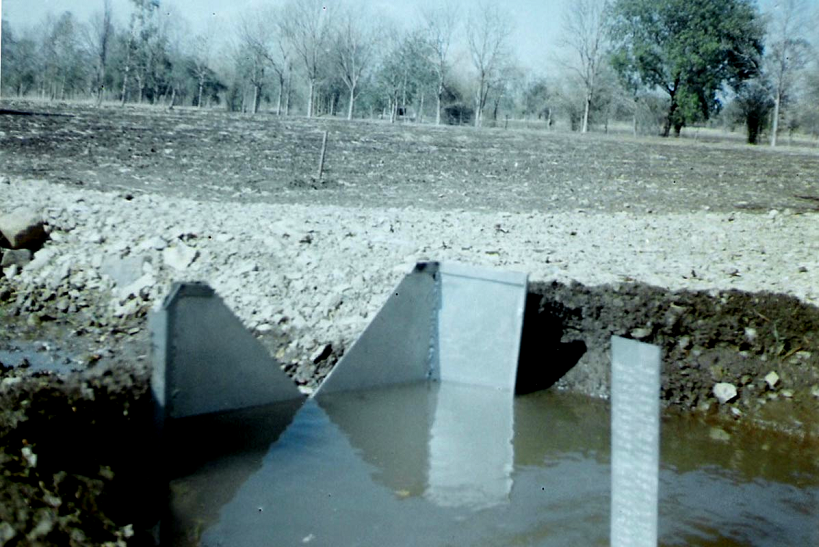
- It is recommended to use PDKV ‘V’ notch (modified ‘V’ notch) to measure the flow of irrigation water.
 |  |
- It is recommended to use the PDKV developed equations for prediction of weekly pan evaporation for Akola and Nagpur regions.
| Pan Evaporation for Akola Region = | – 7.0587 + 0.3151 Max. Temperature + 0.1410 Min. Temperature – 0.0345 Morn. Relative Humidity – 0.0517 Eve. Relative Humidity + 0.3493 Wind Speed + 0.2646 Bright Sunshine Hrs |
| Pan Evaporation for Nagpur Region = | – 5.2600 + 0.2496 Max. Temperature + 0.0801 Min. Temperature – 0.0268 Eve. Relative Humidity + 0.1208 Wind Speed + 0.0800 Bright Sunshine Hrs |
- It is recommended to use the PDKV developed pan coefficients to estimate the monthly, seasonal & annual reference evapotranspiration of Akola region.
 | Annual pan coefficient: 0.8 |
Monthly pan coefficients:
| Month | Pan coefficient | Month | Pan coefficient |
| January | 0.8 | July | 0.9 |
| February | 0.7 | August | 1.0 |
| March | 0.7 | September | 1.0 |
| April | 0.6 | October | 0.9 |
| May | 0.6 | November | 0.8 |
| June | 0.8 | December | 0.8 |
Seasonal pan coefficients:
| Season | Pan coefficient |
| Summer (10-21 MW) | 0.6 |
| Pre monsoon (22-23 MW) | 0.7 |
| Monsoon (24-39 MW) | 1.0 |
| Post monsoon (40-48 MW) | 0.9 |
| Winter (49-9 MW) | 0.8 |
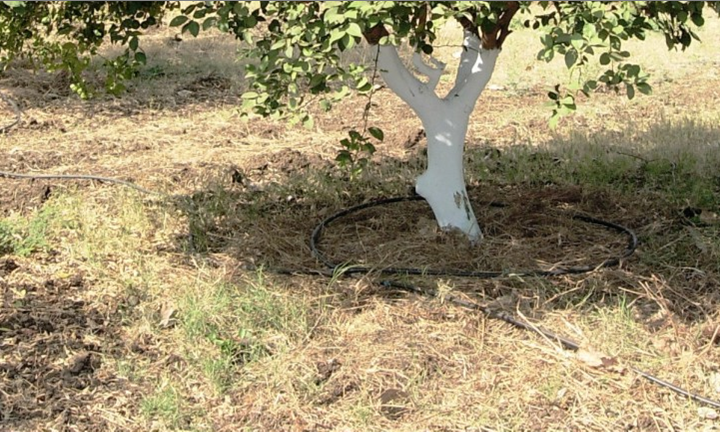
- It is recommended to use HDPE pipes and PVC foot valve combination in pumping system to save energy.
 |
|
- It is recommended to use estimated drainage coefficients for designing agricultural drainage systems for Nagpur and Akola districts.
| Name of crop | Basic infiltration rate of soil (mm/hr) | Drainage coefficient (mm/day) | |
| Nagpur | Akola | ||
| Vegetables | 1 | 106 | 112 |
| 2 | 82 | 88 | |
| 3 | 58 | 64 | |
| 4 | 34 | 40 | |
| 5 | 10 | 16 | |
| Oil seed crops | 1 | 68 | 56 |
| 2 | 44 | 32 | |
| 3 | 20 | 8 | |
| Cotton, Sorghum, Maize, Bajra and other similar crops | 1 | 45 | 33 |
| 2 | 21 | 9 | |
- It is recommended to use drip irrigation system for garlic production as it saves 46% water and gives 20% higher yield over check basin irrigation method.
- It is recommended to use drainage coefficients given in following table for designing agricultural drainage systems for different districts of Vidarbha region.
| Name of crop | Basic infiltration rate (mm/hr) | Drainage coefficient(mm/day) | ||||||||
| Amravati | Buldana | Washim | Yavatmal | Wardha | Gondia | Bhandara | Chandrapur | Gadchiroli | ||
| Vegetables | 1 | 83.46 | 80.60 | 78.63 | 94.84 | 97.74 | 108.88 | 103.03 | 119.42 | 102.71 |
| 2 | 59.46 | 56.60 | 54.63 | 70.84 | 73.74 | 84.88 | 79.03 | 95.42 | 78.71 | |
| 3 | 35.46 | 32.60 | 30.63 | 46.84 | 49.74 | 60.88 | 55.03 | 71.42 | 54.71 | |
| 4 | 11.46 | 8.60 | 6.63 | 22.84 | 25.74 | 36.88 | 31.03 | 47.42 | 30.71 | |
| 5 | — | — | — | — | 1.74 | 12.88 | 7.03 | 23.42 | 6.71 | |
| Oil seed crops | 1 | 41.64 | 50.88 | 48.93 | 55.55 | 56.02 | 76.37 | 58.24 | 72.59 | 66.81 |
| 2 | 17.64 | 26.88 | 24.93 | 31.55 | 32.02 | 52.37 | 34.24 | 48.59 | 42.81 | |
| 3 | — | 2.88 | 0.93 | 7.55 | 8.02 | 28.37 | 10.24 | 24.59 | 18.81 | |
| 4 | — | — | — | — | — | 4.37 | — | 0.59 | — | |
| Cotton, Sorghum, Maize, Bajra and other similar crops | 1 | 26.09 | 37.49 | 30.59 | 34.27 | 34.71 | 54.31 | 45.22 | 52.01 | 48.29 |
| 2 | 2.09 | 13.49 | 6.59 | 10.27 | 10.71 | 30.31 | 21.22 | 28.01 | 24.29 | |
| 3 | — | — | — | — | — | 6.31 | — | 4.01 | 0.29 | |
- It is recommended to use mean weekly reference evapotranspiration given in following table for determining water requirement of different crops at Akola and Nagpur districts of Vidarbha region.
| SMW | Dates | Reference Evapotranspiration (ETo), mm/day | SMW | Dates | Reference Evapotranspiration (ETo), mm/day | ||
| Akola | Nagpur | Akola | Nagpur | ||||
| 1 | 1-7 Jan | 3.0 | 3.0 | 27 | 2-8 | 5.2 | 4.4 |
| 2 | 8-14 | 3.1 | 3.0 | 28 | 9-15 | 4.7 | 3.9 |
| 3 | 15-21 | 3.4 | 3.3 | 29 | 16-22 | 4.3 | 3.8 |
| 4 | 22-28 | 3.5 | 3.5 | 30 | 23-29 | 4.0 | 3.6 |
| 5 | 29-4 Feb | 3.7 | 3.7 | 31 | 30-5 Aug | 3.9 | 3.5 |
| 6 | 5-11 | 4.0 | 4.0 | 32 | 6-12 | 3.7 | 3.4 |
| 7 | 12-18 | 4.4 | 4.4 | 33 | 13-19 | 4.0 | 3.5 |
| 8 | 19-25 | 4.7 | 4.7 | 34 | 20-26 | 3.9 | 3.7 |
| 9 | 26-4 Mar | 5.2 | 5.1 | 35 | 27-2 Sep | 4.0 | 3.6 |
| 10 | 5-11 | 5.4 | 5.4 | 36 | 3-9 | 4.3 | 3.9 |
| 11 | 12-18 | 5.7 | 5.5 | 37 | 10-16 | 4.5 | 4.0 |
| 12 | 19-25 | 6.2 | 6.0 | 38 | 17-23 | 4.4 | 4.2 |
| 13 | 26-1 Apr | 6.5 | 6.4 | 39 | 24-30 | 4.4 | 4.4 |
| 14 | 2-8 | 6.9 | 6.5 | 40 | 1-7 Oct | 4.3 | 4.3 |
| 15 | 9-15 | 7.4 | 6.8 | 41 | 8-14 | 4.1 | 4.3 |
| 16 | 16-22 | 8.0 | 7.4 | 42 | 15-21 | 3.9 | 4.2 |
| 17 | 23-29 | 8.2 | 7.4 | 43 | 22-28 | 3.8 | 4.1 |
| 18 | 30- 6 May | 8.8 | 7.9 | 44 | 29-4 Nov | 3.8 | 3.9 |
| 19 | 7-13 | 9.4 | 8.2 | 45 | 5-11 | 3.5 | 3.8 |
| 20 | 14-20 | 10.0 | 8.2 | 46 | 12-18 | 3.3 | 3.5 |
| 21 | 21-27 | 10.2 | 8.6 | 47 | 19-25 | 3.2 | 3.4 |
| 22 | 28-3 Jun | 9.9 | 8.3 | 48 | 26-2 Dec | 3.1 | 3.2 |
| 23 | 4-10 | 8.8 | 7.5 | 49 | 3-9 | 3.0 | 3.1 |
| 24 | 11-17 | 7.2 | 6.2 | 50 | 10-16 | 2.9 | 3.0 |
| 25 | 18-24 | 6.3 | 5.3 | 51 | 17-23 | 2.9 | 2.9 |
| 26 | 25-1 Jul | 5.6 | 4.5 | 52 | 24-31 | 2.9 | 3.0 |
- It is recommended to use PDKV developed drainage coefficients for designing agricultural drainage systems for respective tehsils of different districts of Vidarbha region.
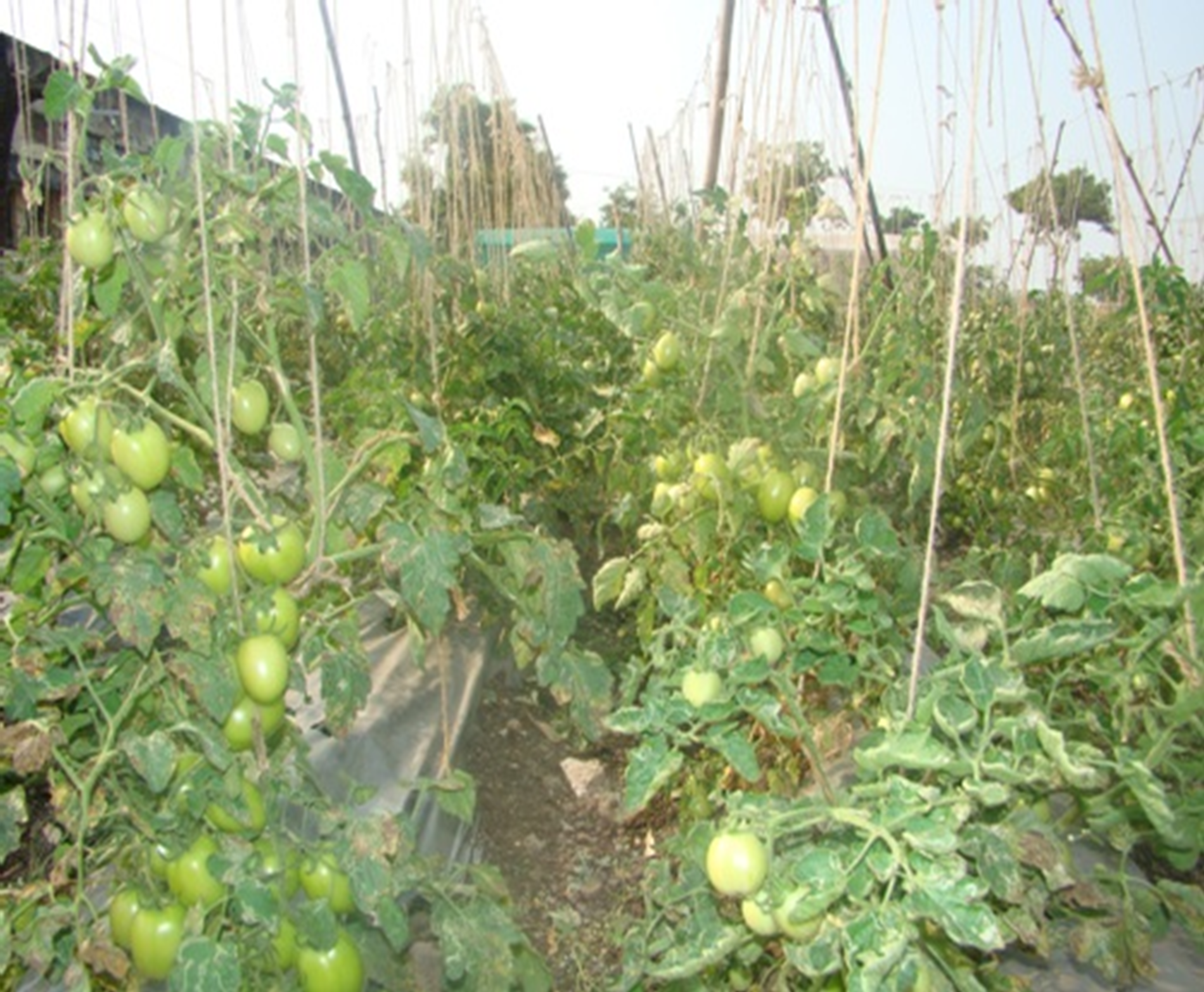
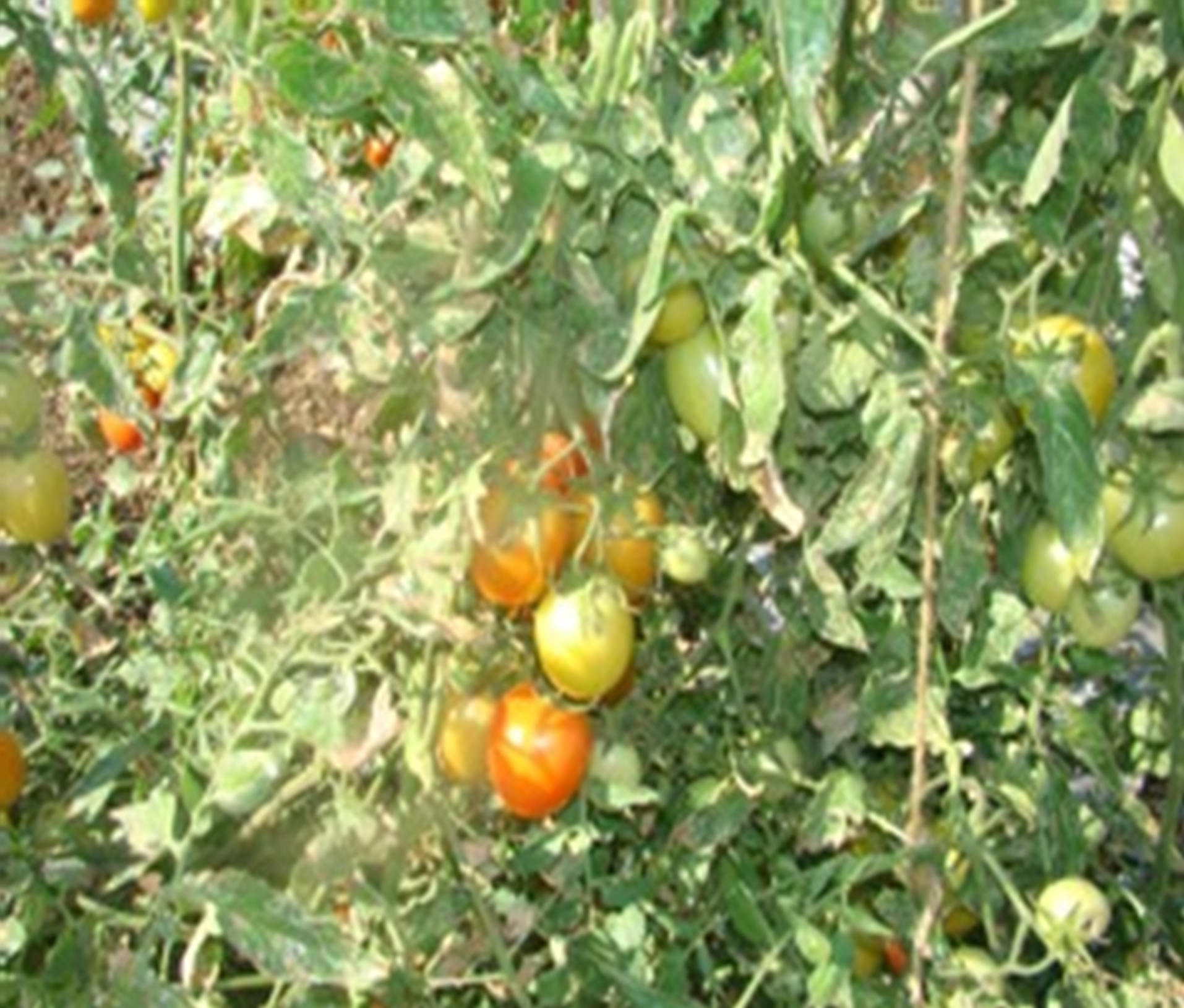
- It is recommended to use drip irrigation at 80% ET with polyethylene mulch (silver black, 50 micron) for highest growth and yield of tomato crop with highest B:C ratio.
 |  |
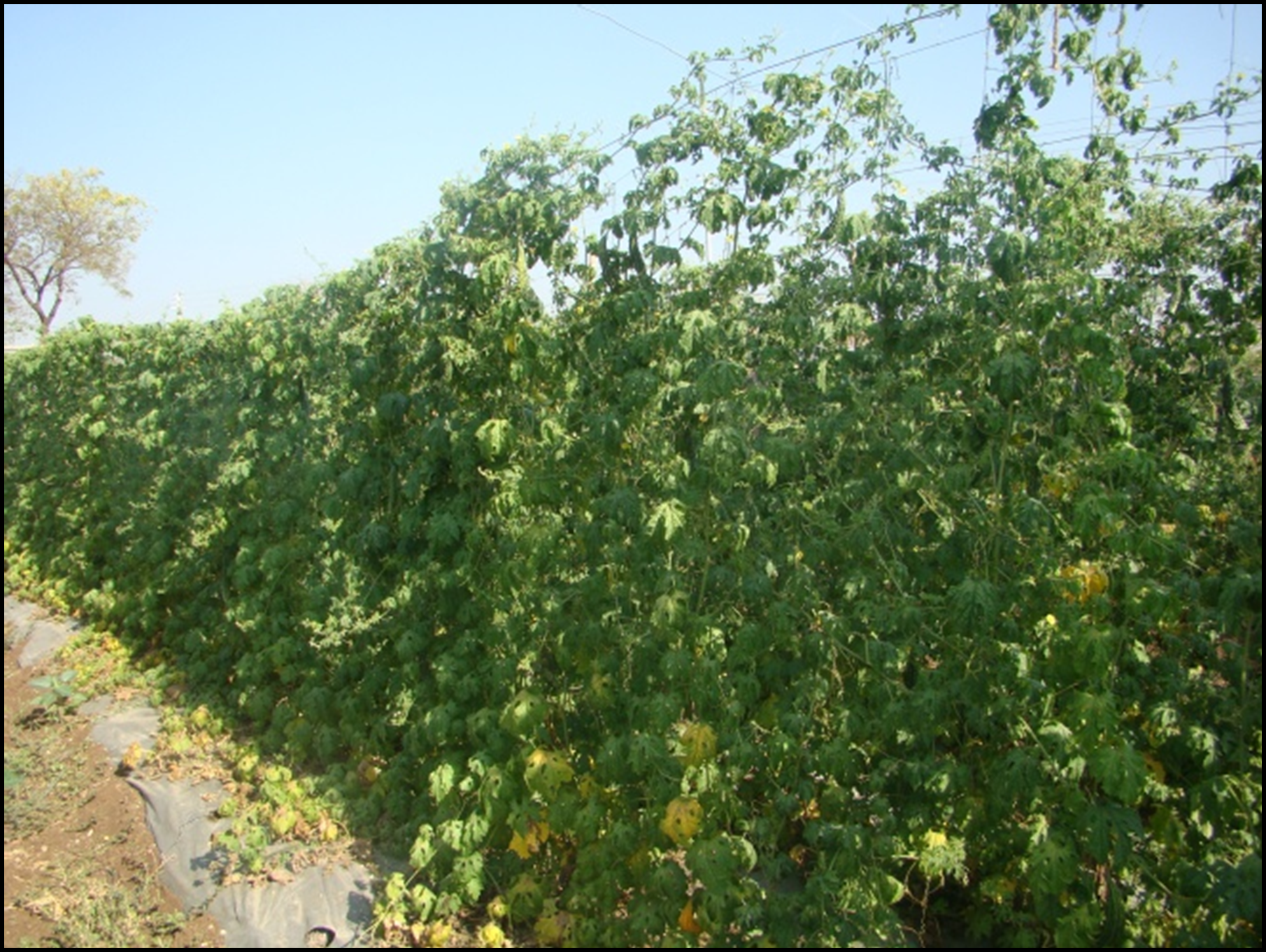
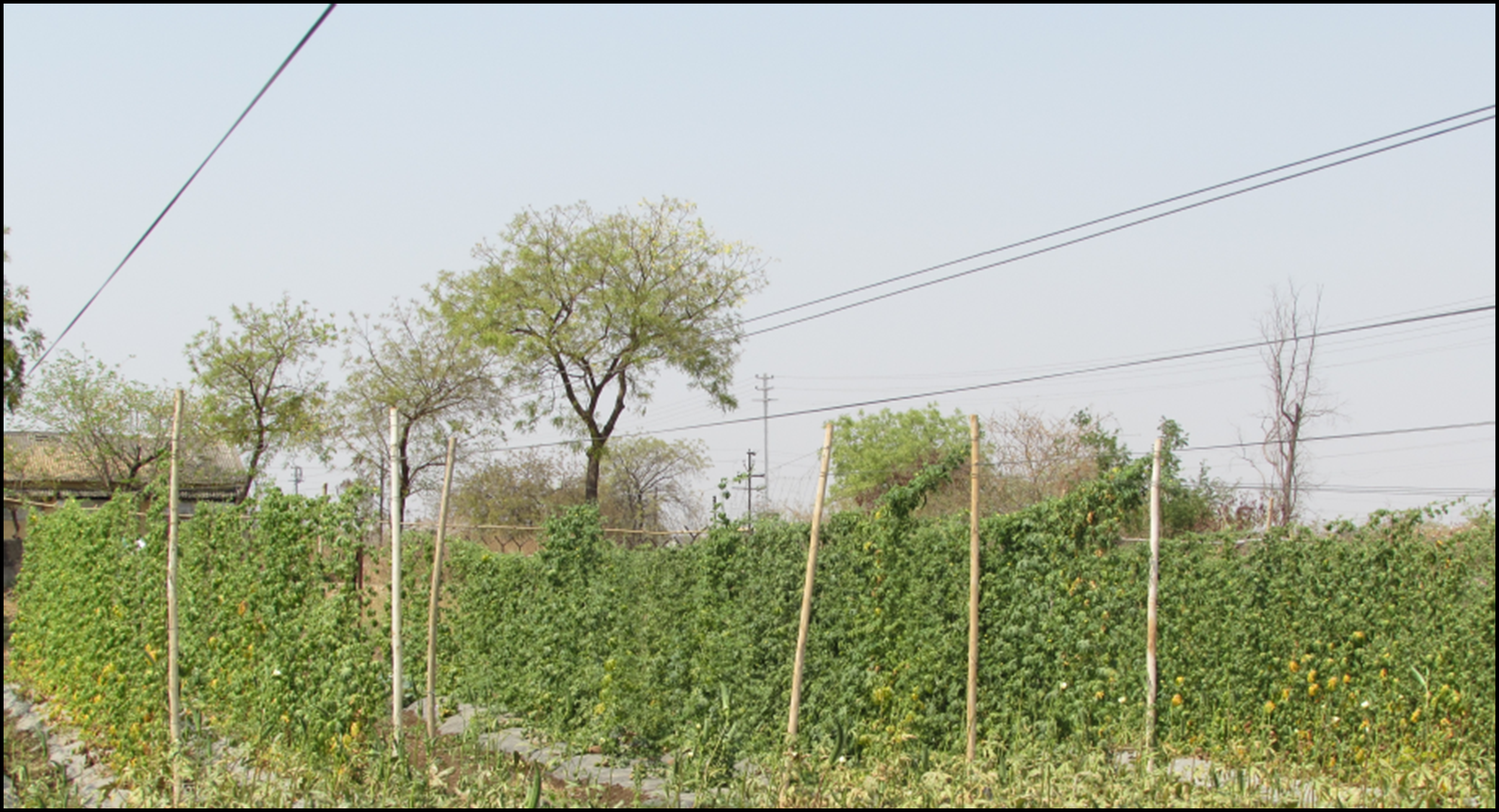
- It is recommended to use drip irrigation at 80% ETc with black polyethylene mulch during winter season for highest growth and yield of bitter gourd crop.
 |  |
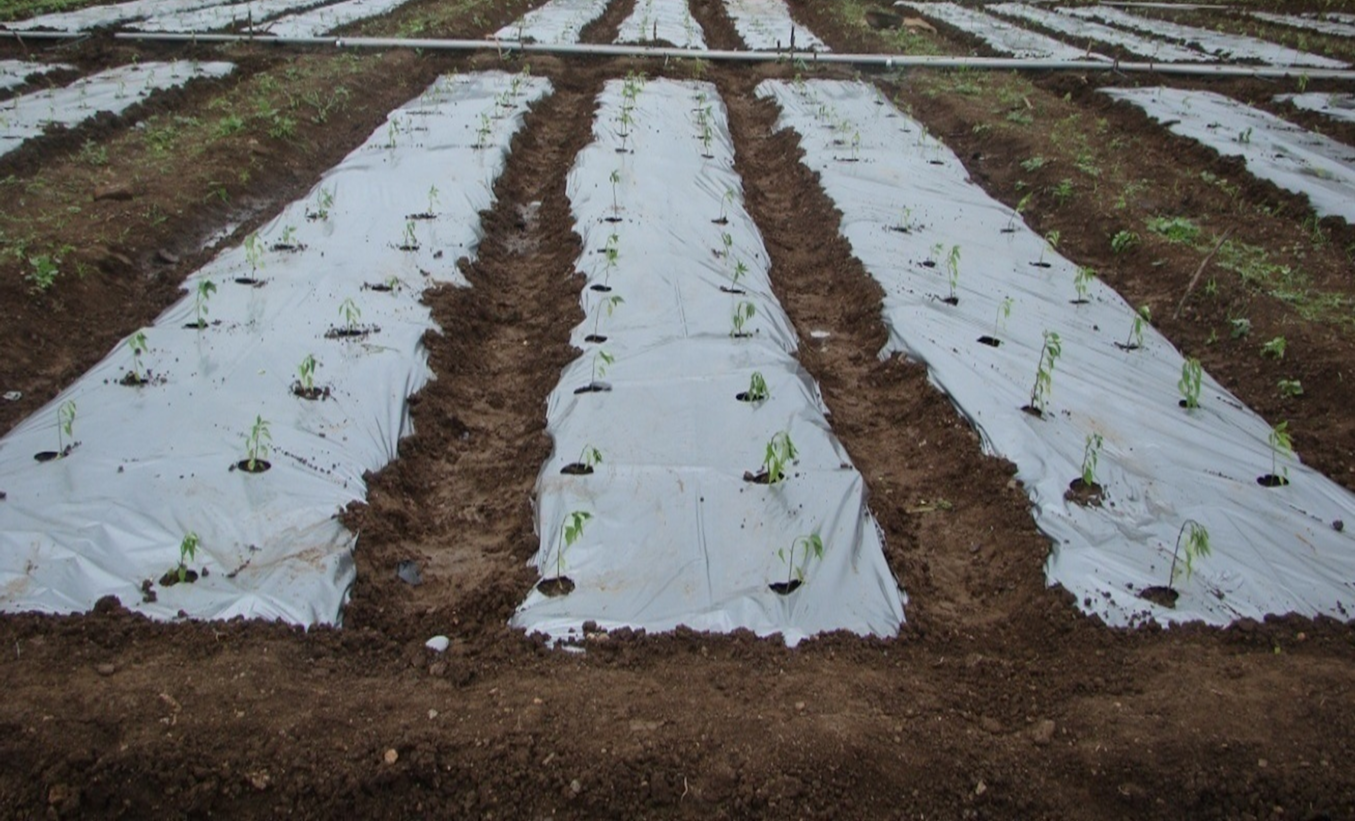
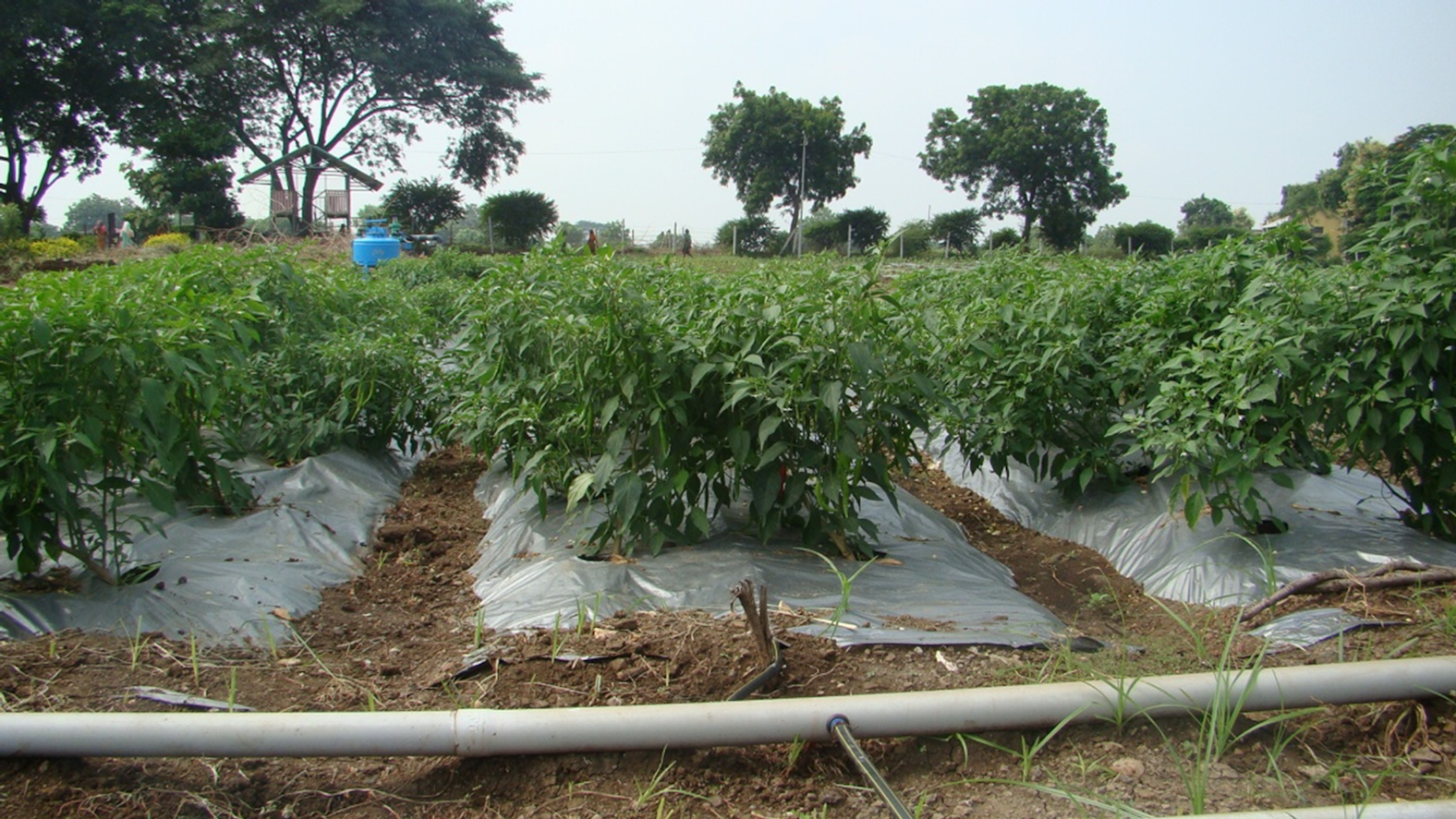
- It is recommended to use drip irrigation at 80% evapotranspiration replenishment with polyethylene mulch (silver colour and 50 micron thickness) for highest growth and yield of chilli crop.
 |  |
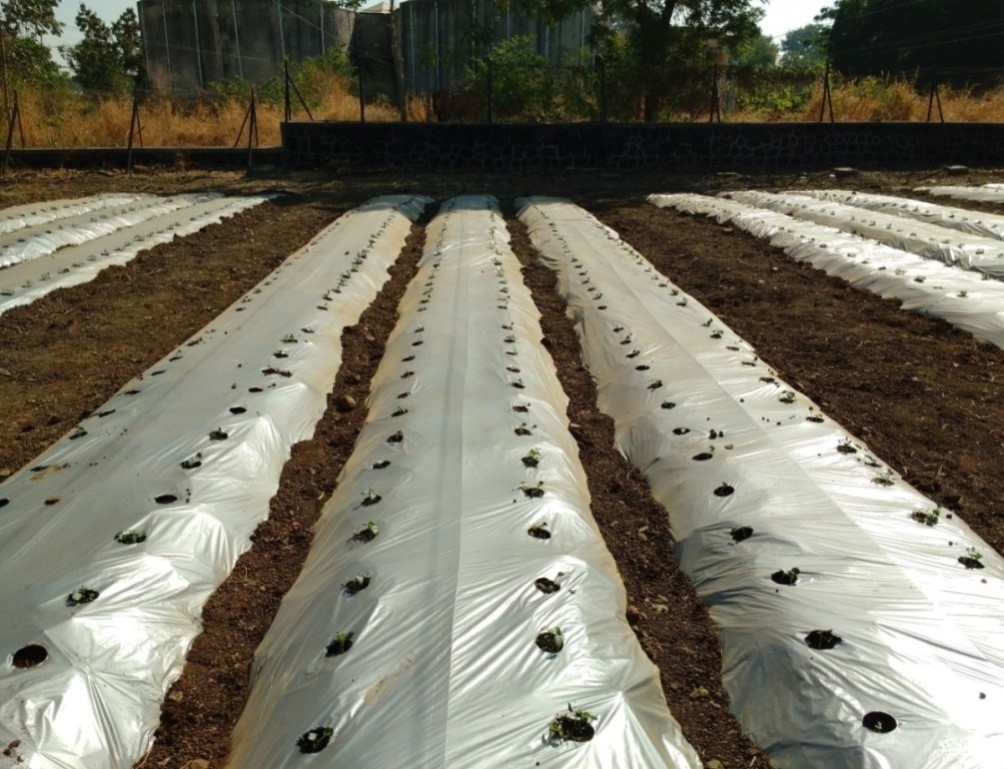
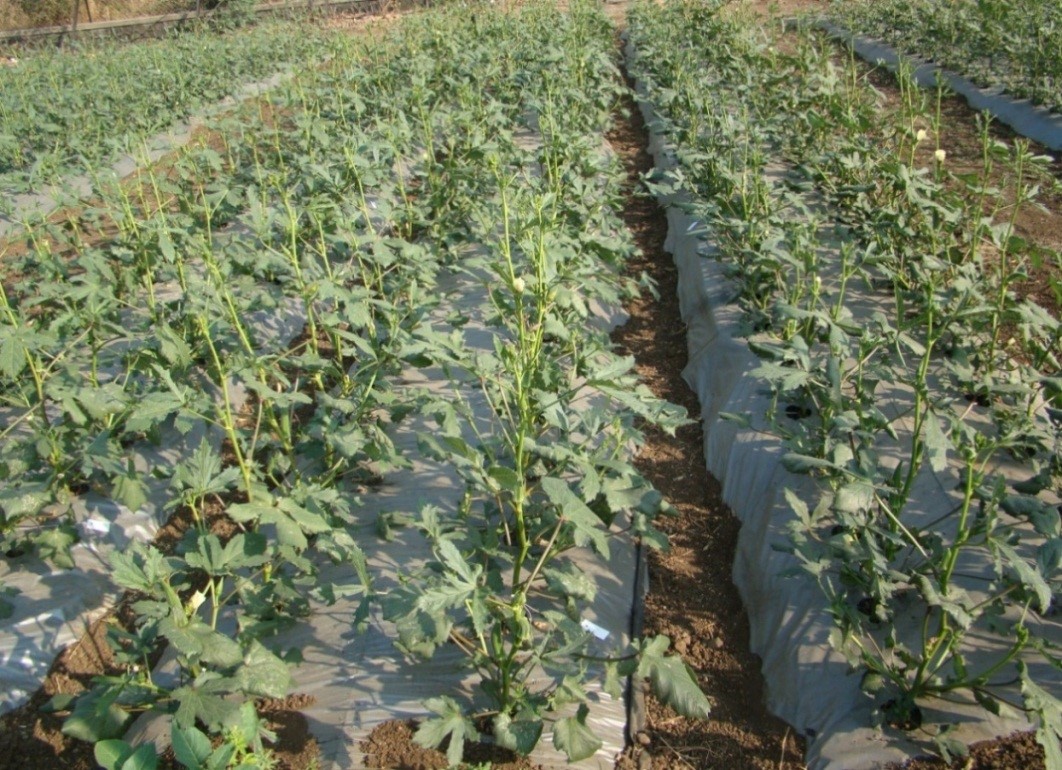
- It is recommended to use 50 micron silver-black polyethylene mulch with 80 per cent crop evapotranspiration and 80 per cent RDF (80:40:40 NPK Kg/ha) through drip irrigation for higher yield of Okra crop and highest B:C ratio.
 |  |
- For higher onion bulb yield and economic returns it is recommended to use crop spacing of 10 x 7.5 cm with application of 100 per cent of RDF (i.e. 100:50:50 NPK, kg/ha) under drip fertigation.
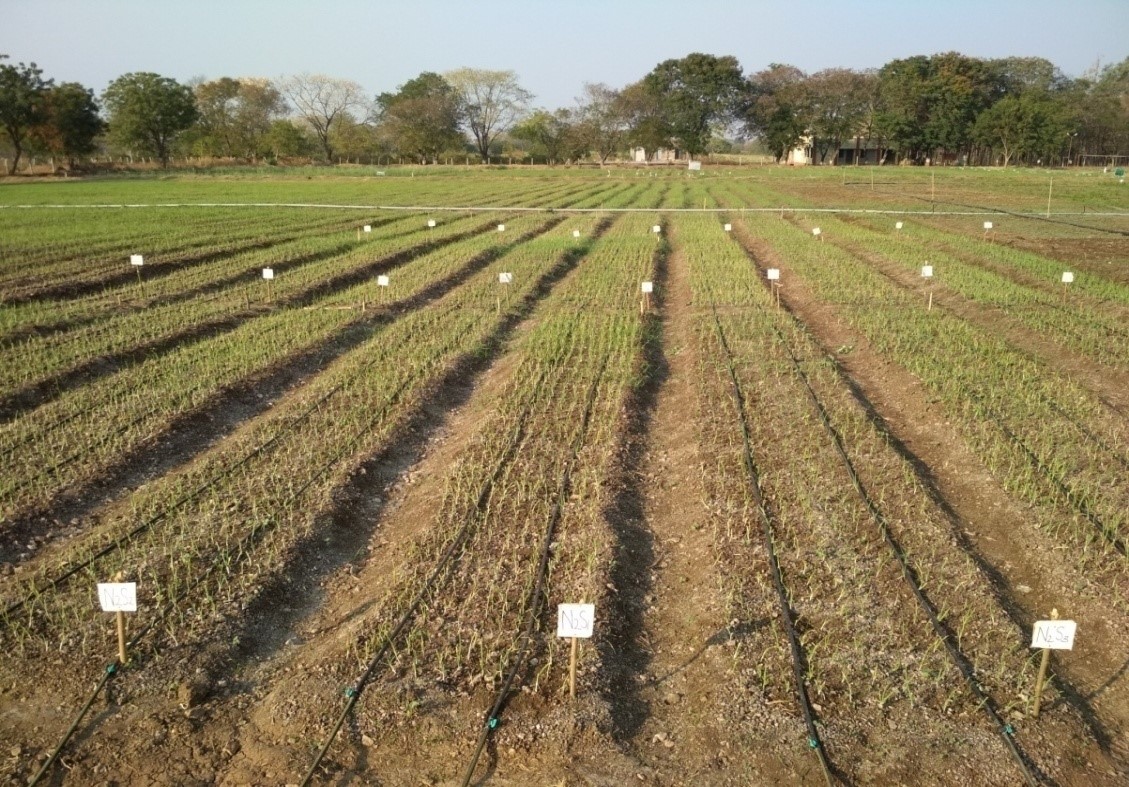 | 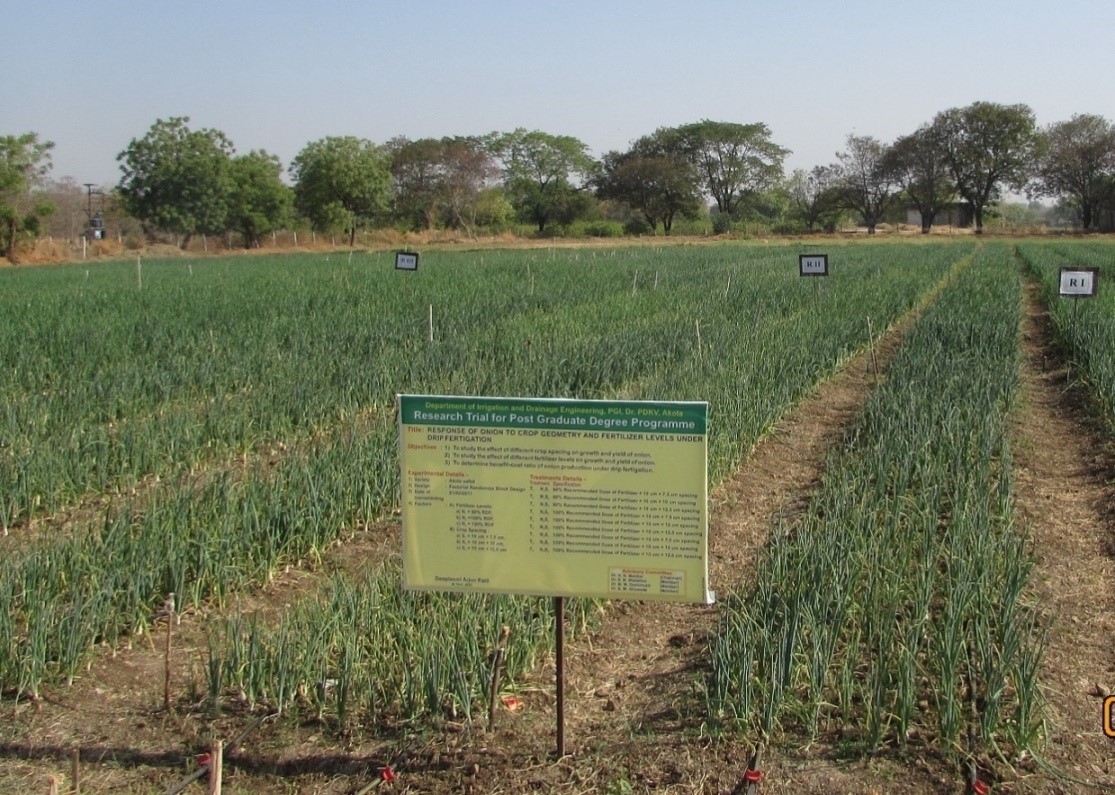 |
- For higher onion bulb yield and economic returns it is recommended to use crop spacing of 10 x 7.5 cm with application of 100 per cent of RDF (i.e. 100:50:50 NPK, kg/ha) under drip fertigation.
|
|
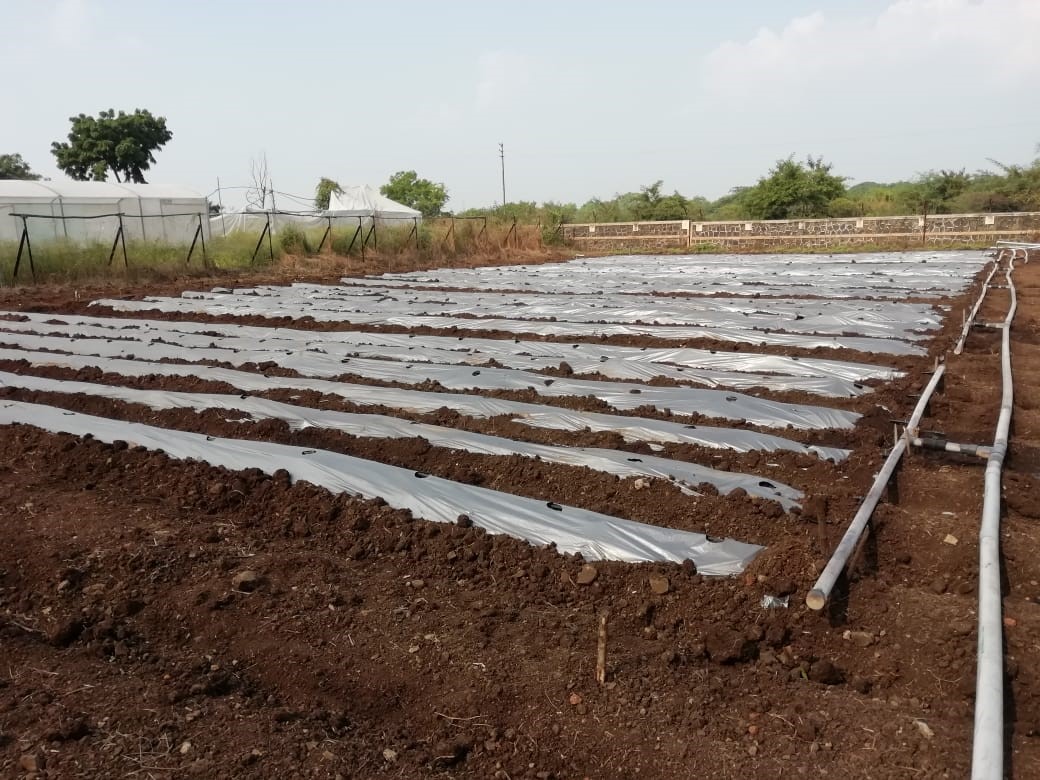
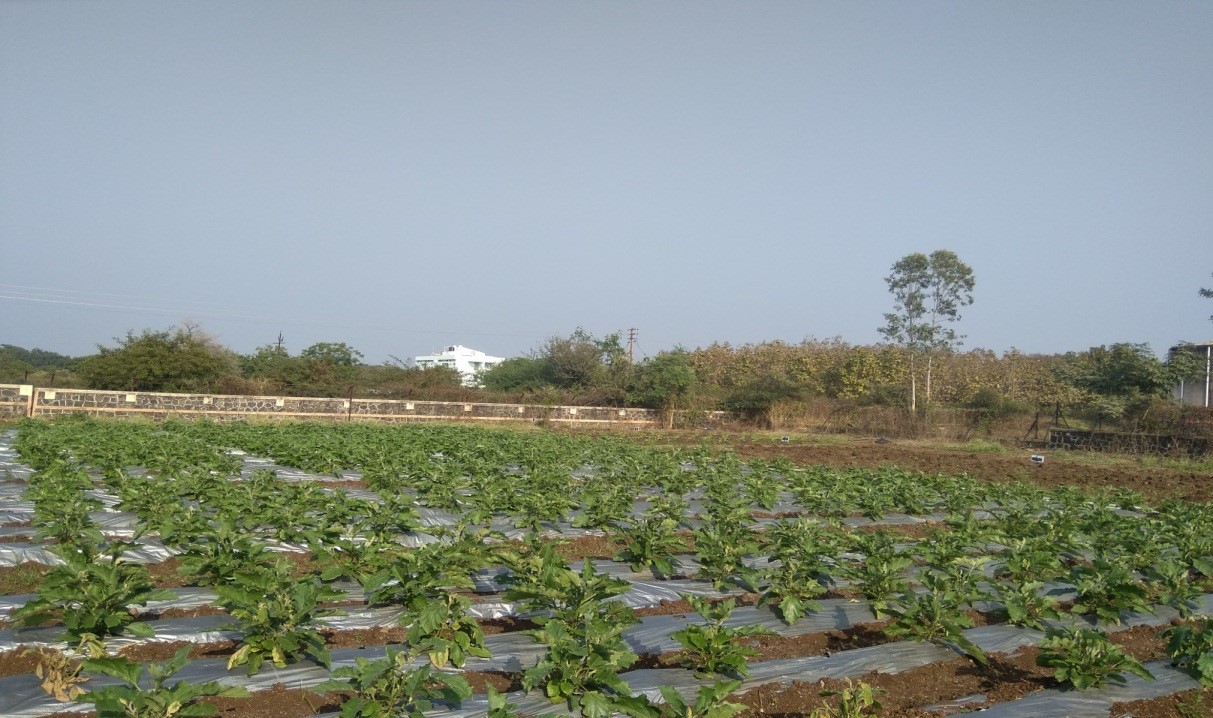
- It is recommended to use drip fertigation with fertilizer level of 125 % RDF (i.e. 188:94:94 N:P2O5:K2O kg ha-1) to be applied in 15 splits at an interval of 10 days (half dose in first 6 equal splits and remaining half dose in 9 equal splits) and 80 % replenishment of ETc along with silver polyethylene mulch, to obtain higher yield of brinjal and benefit cost ratio.
 |  |
- It is recommended to use Dr. PDKV developed weekly mean reference evapotranspiration for determining water requirement of different crops for all tahsils of Vidarbha. Similarly, it is recommended to use maps developed in GIS for determining mean reference evapotranspiration of specific week at specific location.
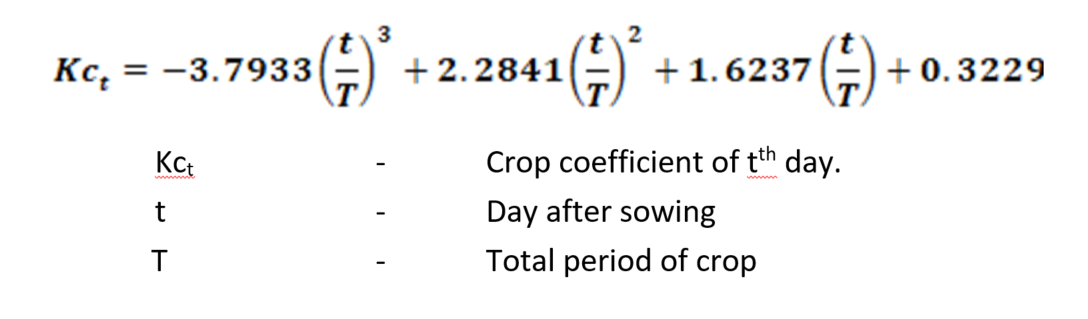
- It is recommended to use the crop coefficient values given in table for determining water requirement of summer sesame crop.
| Week after sowing | Crop coefficient | Week after sowing | Crop coefficient |
| 1 | 0.43 | 10 | 1.3 |
| 2 | 0.55 | 11 | 1.29 |
| 3 | 0.68 | 12 | 1.23 |
| 4 | 0.81 | 13 | 1.12 |
| 5 | 0.93 | 14 | 0.97 |
| 6 | 1.05 | 15 | 0.77 |
| 7 | 1.15 | 16 | 0.57 |
| 8 | 1.23 | 17 | 0.47 |
| 9 | 1.28 |
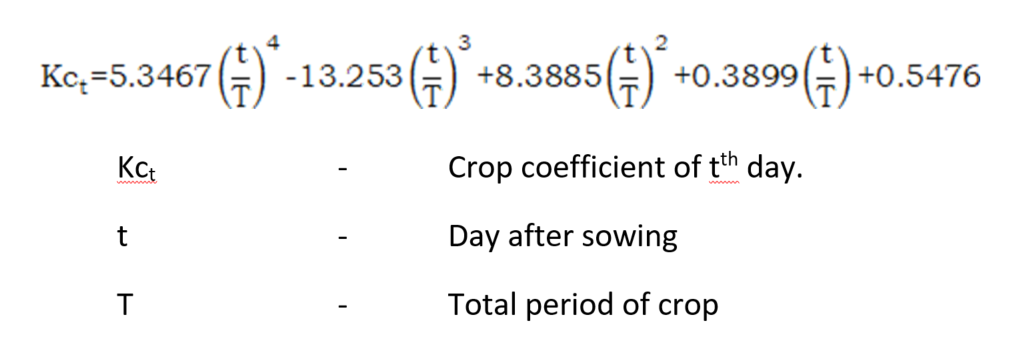
Alternative for above table following equation is recommended.
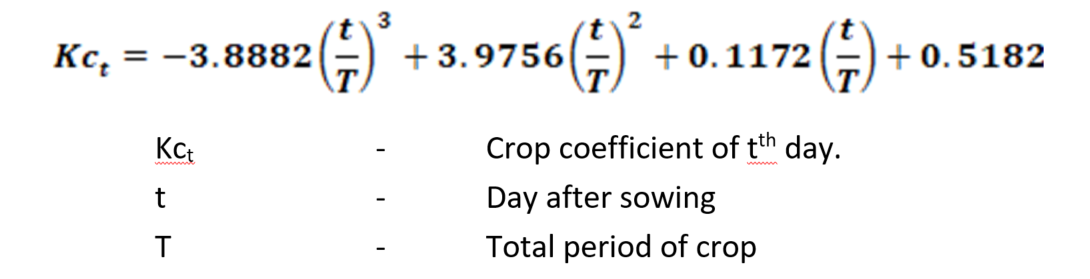
- It is recommended to use the crop coefficient values given in table for determining water requirement of summer green gram crop.
| Week after sowing | Crop coefficient | Week after sowing | Crop coefficient |
| 1 | 0.56 | 7 | 1.2 |
| 2 | 0.65 | 8 | 1.21 |
| 3 | 0.77 | 9 | 1.15 |
| 4 | 0.9 | 10 | 0.99 |
| 5 | 1.03 | 11 | 0.72 |
| 6 | 1.13 |
Alternative for above table following equation is recommended.
- For estimation of near real time spatial and temporal crop coefficient values and getting accurate water requirement of rabi wheat and onion, it is recommended to use Normalized Difference Water Index (NDWI) based following equations:
For wheat: Kc = 3.608 × NDWI + 0.433
For onion : Kc = 3.231 × NDWI + 0.603
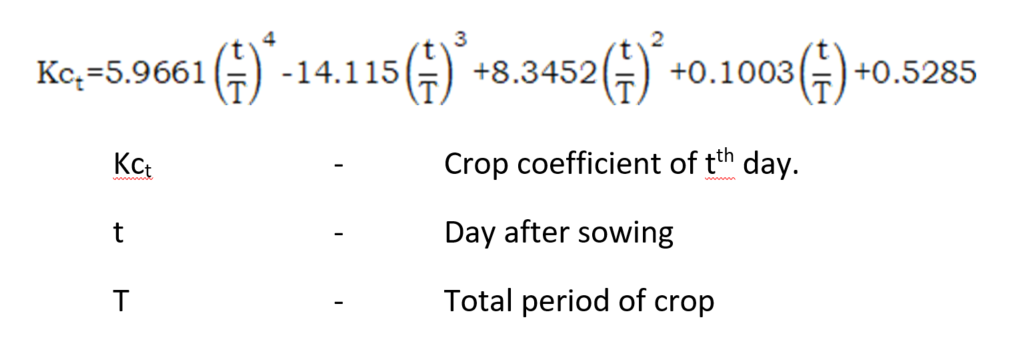
- It is recommended to use the crop coefficient values given in table for determining water requirement of cotton crop.
| Week after sowing | Crop coefficient | Week after sowing | Crop coefficient |
| 1 | 0.54 | 13 | 1.19 |
| 2 | 0.57 | 14 | 1.20 |
| 3 | 0.62 | 15 | 1.19 |
| 4 | 0.68 | 16 | 1.17 |
| 5 | 0.75 | 17 | 1.13 |
| 6 | 0.83 | 18 | 1.08 |
| 7 | 0.90 | 19 | 1.02 |
| 8 | 0.97 | 20 | 0.95 |
| 9 | 1.04 | 21 | 0.87 |
| 10 | 1.09 | 22 | 0.79 |
| 11 | 1.14 | 23 | 0.71 |
| 12 | 1.17 | 24 | 0.62 |
Alternative for above table following equation is recommended.
- It is recommended to use the crop coefficient values given in table for determining water requirement of pigeon pea crop.
| Week after sowing | Crop coefficient | Week after sowing | Crop coefficient |
| 1 | 0.54 | 14 | 1.15 |
| 2 | 0.56 | 15 | 1.16 |
| 3 | 0.59 | 16 | 1.16 |
| 4 | 0.64 | 17 | 1.15 |
| 5 | 0.70 | 18 | 1.13 |
| 6 | 0.76 | 19 | 1.10 |
| 7 | 0.82 | 20 | 1.05 |
| 8 | 0.88 | 21 | 1.00 |
| 9 | 0.94 | 22 | 0.94 |
| 10 | 1.00 | 23 | 0.87 |
| 11 | 1.05 | 24 | 0.79 |
| 12 | 1.09 | 25 | 0.72 |
| 13 | 1.13 | 26 | 0.64 |
- For clay loam soils in western Vidarbha region, it is recommended that the overhead sprinkler (4ft, 9 lpm, 50% overlapping) should be operated for four hours during critical stages of chickpea i.e. flowering and pod formation to maintain favourable moisture content in the root zone.
- For high density plantation of Nagpur mandarin with spacing of 6m x 3m (Fully matured), application of water soluble fertilizers through drip fertigation with the dose of 663-220-330 (N-P-K, g/pant) or 368 – 122 – 183, (N-P-K, kg/ha) in 18 splits at 14 days interval as per schedule given below is recommended for getting higher yield and superior quality of fruits, with more economic returns.
Split schedule for fertigation:
| Sr. No. | Stage | No of Days | No of splits | Split No. | Quantity of fertilizers through drip g/plant | |||||
| N | P | K | ||||||||
| g/plant | kg/ha | g/plant | kg/ha | g/plant | kg/ha | |||||
| 1 | Blossom | 42 | 03 | 1 | 55.24 | 30.66 | 21.98 | 12.2 | 27.48 | 15.25 |
| 2 | 55.24 | 30.66 | 21.98 | 12.2 | 27.48 | 15.25 | ||||
| 3 | 55.24 | 30.66 | 21.98 | 12.2 | 27.48 | 15.25 | ||||
| 2 | Fruit set | 42 | 03 | 4 | 55.24 | 30.66 | 21.98 | 12.2 | 27.48 | 15.25 |
| 5 | 55.24 | 30.66 | 21.98 | 12.2 | 27.48 | 15.25 | ||||
| 6 | 55.24 | 30.66 | 21.98 | 12.2 | 27.48 | 15.25 | ||||
| 3 | Fruit Growth Stage 1 | 84 | 06 | 7 | 38.67 | 21.46 | 7.32 | 4.06 | 16.49 | 9.15 |
| 8 | 38.67 | 21.46 | 7.32 | 4.06 | 16.49 | 9.15 | ||||
| 9 | 38.67 | 21.46 | 7.32 | 4.06 | 16.49 | 9.15 | ||||
| 10 | 38.67 | 21.46 | 7.32 | 4.06 | 16.49 | 9.15 | ||||
| 11 | 38.67 | 21.46 | 7.32 | 4.06 | 16.49 | 9.15 | ||||
| 12 | 38.67 | 21.46 | 7.32 | 4.06 | 16.49 | 9.15 | ||||
| 4 | Fruit Growth Stage 2 | 84 | 06 | 13 | 16.50 | 9.16 | 7.32 | 4.06 | 10.99 | 6.1 |
| 14 | 16.50 | 9.16 | 7.32 | 4.06 | 10.99 | 6.1 | ||||
| 15 | 16.50 | 9.16 | 7.32 | 4.06 | 10.99 | 6.1 | ||||
| 16 | 16.50 | 9.16 | 7.32 | 4.06 | 10.99 | 6.1 | ||||
| 17 | 16.50 | 9.16 | 7.32 | 4.06 | 10.99 | 6.1 | ||||
| 18 | 16.50 | 9.16 | 7.32 | 4.06 | 10.99 | 6.1 | ||||
| Total | 252 | 18 | 663.06 | 368 | 220 | 122 | 330 | 183 | ||